Episode 1 Season 2: The Power of One: How Giving While Black Is Redefining Philanthropy Through Everyday Kindness

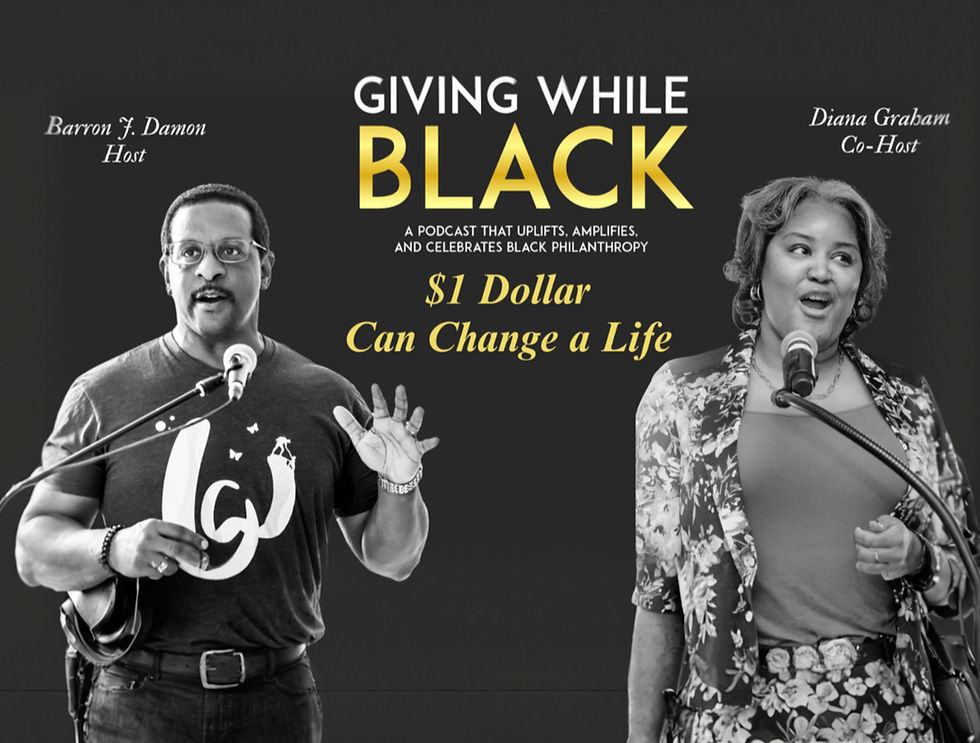
As Giving While Black launches into a powerful new season, host Barron J. Damon made one thing clear from the opening moments: this season is about more than conversation—it’s about transformation. With the introduction of co-hosts and a renewed educational focus through the Business of Giving Studio, the podcast is expanding its mission to both entertain and equip listeners with real-world tools for impactful philanthropy.
Joining Baron for this season-opening episode was his newest co-host and collaborator, Diana Nicole Graham—Army combat veteran, entrepreneur, and founder of Crown for Success Global Consulting. Their chemistry was immediate, grounded in shared values around service, community, and the belief that everyone—regardless of income or status—has something meaningful to give.
Diana, a proud native of China Grove, North Carolina, described herself simply as “a lover of people.” For her, philanthropy begins with recognizing people as the greatest asset. “If we would see people as our greatest asset,” she said, “we would serve in a different way.” That philosophy drives her work at Crown for Success Global Consulting, where she helps organizations develop their people through human capital training, leadership development, and purpose-driven program design.
Her leadership philosophy was forged in the military during Operation Iraqi Freedom. At just 22 years old, Diana learned firsthand the power of teamwork under life-and-death pressure. “Down range, you don’t care what branch someone is in,” she explained. “You just need someone to come to your rescue.” That understanding—that every person has value and every role matters—now shapes how she builds organizations and communities.
One of the most powerful stories shared during the episode centered on the Veterans Life Center in North Carolina. Diana and her team helped take a simple idea from a returning veteran and transform it into a multimillion-dollar campus now housing over 100 transitioning veterans. One resident arrived in the dead of winter, surviving by trapping squirrels for food. Today, that same individual is employed, housed, and has won $10,000 in an entrepreneurial pitch competition. “That’s what infrastructure does,” Diana said. “It turns survival into sustainability.”
Yet the heart of the episode wasn’t just about large-scale impact—it was about the unseen power of small acts. A viral video shared during the show told the story of nine-year-old Kelvin Ellis, who gave the only dollar he owned to a man he thought was homeless outside a coffee shop. That man turned out to be a multimillionaire business owner, who rewarded Kelvin with kindness, opportunity, and mentorship. But Kelvin’s reward, he said, wasn’t the shopping spree—it was joy.
That moment set the tone for the central message of the episode: the power of one. One dollar. One conversation. One act of kindness. One moment of attention.
Barron reinforced that truth with a deeply moving personal story. Years earlier, his foundation awarded its very first scholarship—just $500—to a student named Victor. Victor, an undocumented A student with little hope of funding, cried as if he had been given five million dollars. That $500 changed his life. It opened doors to mentors, legal advice, and ultimately to a full four-year scholarship at Tufts University—$80,000 per year. Today, Victor is preparing for a PhD in engineering and mentoring others. “It wasn’t the money,” Barron said. “It was the hope.”
The ripple effect of generosity became a recurring theme throughout the episode. Diana pointed out that many gifts feel “small” to the giver but become life-altering for the receiver. “Be comfortable with your level of giving,” she encouraged. “Because what feels small to you may be transformational to someone else.”
The discussion also challenged a common myth: that philanthropy belongs only to the wealthy. Research revealed that Black Americans donate a higher percentage of their wealth than other racial groups despite the racial wealth gap. Black households contribute an estimated $11 billion annually to community organizations—much of it undocumented through church giving, community support, and family generosity.
As Diana reflected, “There are so many unrecorded moments—money passed through hands at graduations, funerals, college send-offs. It’s our culture.”
The episode ended with a bold challenge: one million random acts of kindness. Baron invited listeners to participate, document their giving, and share it using hashtags like #IGave, #GiveWhileBlack, and #LegacyUnfolding. From paying for groceries to supporting scholarships, the call was clear—don’t wait to be rich to be generous.
As the season unfolds, Giving While Black is not just telling stories of generosity—it is activating it. Through voices like Diana Graham and everyday heroes like Kelvin and Victor, the show proves that philanthropy isn’t defined by bank accounts. It’s defined by attention, intention, and action.
Because in the end, the future doesn’t change through grand gestures alone—it changes through the quiet power of one.In the latest episode of "Given While Black," host Barron J introduces Cedric June, a philanthropist dedicated to uplifting his community through education and mentorship. As the conversation unfolds, it becomes evident that Cedric’s life is a testament to the transformative power of giving back, both in terms of financial support and the invaluable transfer of knowledge.


Comments